Integrated photonics · Inverse design of glass photonics · Research project

KIBOD

Inverse design of ion-exchange glass photonics, from specification to a ready-to-expose mask.

Ion exchange (IOX) writes optical structures into glass: in a salt melt, silver ions diffuse into the glass surface through openings in a mask, locally raising the refractive index so that light is guided there. The process is fast, cost-effective, and allows panel-level fabrication and integration of electric connections alongside optical waveguides for future photonic chips. KIBOD (KI-basierte Optimierungsalgorithmen für das inverse photonische Design) designs complex compact devices made this way: power splitters, wavelength demultiplexers and more! It works backwards from the specification: engineers define where the light should go, and KIBOD optimizes the mask so that ion diffusion creates a refractive-index landscape that steers the light exactly where it should be to match the spec.

From a device description to a manufacturable mask.

Why we built it. What we did. What is new.

Glass is becoming a substrate for photonic packaging: with ion exchange (IOX), waveguides can be written directly into glass panels. Devices built this way are often several millimetres long, which is a major challenge for their design, as classical simulations must still be done at a resolution of a fraction of a wavelength, which means billions of voxels to churn through if the design is done numerically. That's why only simple devices which can be computed analytically are mostly designed this way. Inverse design, where an optimizer works out the structure that produces the required outputs, can make far more complex and compact devices needed for real industrial applications. With many thousands of iterations required and a single FDTD simulation of a glass device taking hours, it is, however, challenging to do. Here's why KIBOD matters.
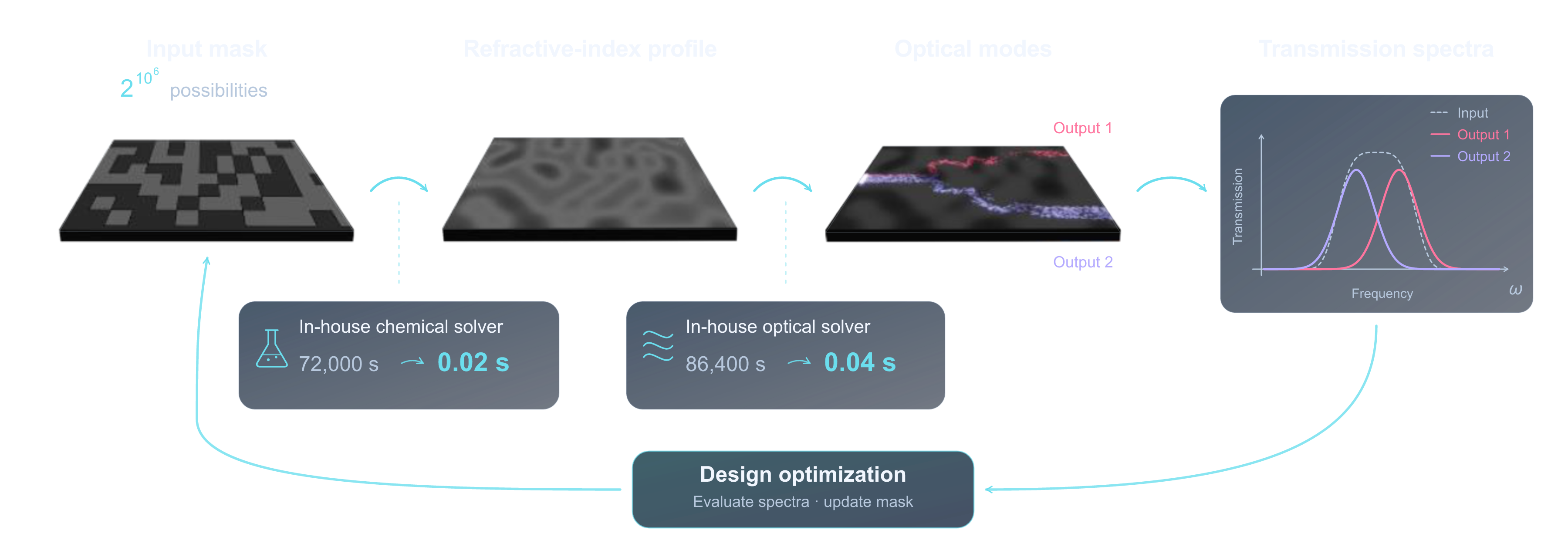
KIBOD schematic

OLT built an inverse-design pipeline for IOX glass photonics. The user specifies inputs and target outputs, for example a 1×N splitter with given power ratios or a wavelength demultiplexer, and the pipeline optimizes the mask so that silver ions diffuse where they are needed to guide the light. Designs can be set up in a web app through a natural-language agent or programmatically with a Python client, and many designs can run in parallel on a single production-grade backend.

OLT contribution

OLT develops all the numerics: hybrid solvers for ion diffusion and light propagation that are six orders of magnitude faster than state of the art, the joint diffusion-optics optimization, including manufacturing constraints that keep designs robust in fabrication, and the scalable multi-user platform with web and API access, steerable with natural language by an agent.

Diffusion and light propagation are solved jointly and fast enough for gradient-based optimization, using the same methods that train LLMs. That allows optimizing binary masks with millions of pixels directly and designing devices with arbitrary pre-defined output fields. The solvers are validated against state-of-the-art commercial solvers, and Fraunhofer IZM fabricates and characterizes several batches of real devices.

Co-developed with Fraunhofer IZM and TU Berlin, and funded by ZIM. The approach can be extended to other glass technologies, such as femtosecond laser writing and electric-field-assisted diffusion, which we plan to do next.

Where it fits and what makes it different.

What makes this different

  • Six orders of magnitude faster than FDTD, validated numerically against commercial solvers.
  • Optimizes binary masks with millions of pixels directly, respecting manufacturing constraints.
  • Arbitrary target outputs: power splitters, wavelength demultiplexers and more. Visible and near-infrared light.
  • Delivers simulated fields, as well as a ready-to-print DXF mask for panel-level IOX fabrication.

Market landscape

Competitor / approachWhat they doDifference / gap
Lumerical lumopt (Synopsys)Python-based continuous adjoint optimization wrapper for Lumerical that performs parametric and topology optimization of photonic devices with multiple objectives and constraints, with examples such as grating couplers, waveguide crossings and Y-branches.KIBOD couples ion-diffusion and light-propagation solvers, so the optimizer works directly on the binary diffusion mask under manufacturing constraints and delivers a DXF mask ready for panel-level IOX fabrication.
Flexcompute Tidy3D inverse designGPU-based FDTD solver with automatic differentiation that uses the adjoint method to get gradients from two simulations regardless of the number of design parameters, with tutorials on fabrication-aware inverse design.For millimetre-long IOX glass devices, KIBOD uses hybrid diffusion and light-propagation solvers that are six orders of magnitude faster than the state of the art and validated numerically against commercial solvers.
Keysight RSoft BeamPROP with MOSTBeam propagation method (BPM) tool for designing integrated photonic and fiber-optic devices, paired with the MOST multi-variable optimization and scanning tool that automates device optimizations and parameter scans.KIBOD solves diffusion and light propagation jointly and fast enough for gradient-based optimization, which lets it optimize binary masks with millions of pixels directly.
Optiwave OptiBPMBPM-based CAD tool for designing waveguide devices such as splitters, couplers, multiplexers and modulators, which lists waveguides from a diffused process among its applications and exports GDSII and DXF mask formats.KIBOD works backwards from the specification: engineers set ports, wavelengths and target power ratios in natural language or via the Python client, and the optimizer finds the mask that produces those outputs.

Market insight. Glass is gaining ground as a substrate that carries optical as well as electrical connections: Fraunhofer IZM has transferred ion exchange to large thin-glass panels and notes that industry leaders like Intel are looking to glass as an alternative substrate, and Corning and GlobalFoundries are collaborating on a glass-waveguide edge coupler for co-packaged optics in AI data centers. IDTechEx projects the co-packaged optics market to exceed US$20 billion by 2036, growing at 37% a year from 2026, while adjoint-based inverse design is now offered in commercial photonics tools such as Lumerical and Tidy3D.

Market research compiled 2026-10-27 from public sources: